
finFindR: Top 10 ‘Most Cited’ Marine Mammal Science Papers
Fin matching paper among top 10 most cited articles in Marine Mammal Science during 2022 and 2023
Marine Mammals
Image Recognition
Publications
Wiley reported today that our paper, finFindR: Automated recognition and identification of marine mammal dorsal fins using residual convolutional neural networks, is one of the top 10 most-cited papers in Marine Mammal Science among work published between 1 Jan 2022 and 31 Dec 2023. Yeah!
The Paper
Thompson, J. W., Zero, V. H., Schwacke, L. H., Speakman, T. R., Quigley, B. M., Morey, J. S., McDonald, T. L. (2021) finFindR: Automated recognition and identification of marine mammal dorsal fins using residual convolutional neural networks Marine Mammal Science p. 1-12 https://doi.org/10.1111/mms.12849
Paper Summary
Manually matching fin photos for use in demographic studys is slow and labor-intensive. Our paper introduces finFindR, an open-source application that automates the process using a series of convolutional neural networks. Given an unedited field photograph, finFindR locates the dorsal fin, extracts the individual’s unique fin characteristics, and ranks the most likely matches from an existing catalog.
In blind tests with common bottlenose dolphins (Tursiops truncatus), finFindR matched the accuracy of experienced technicians while dramatically reducing the number of photographs they needed to examine – an average of 10 with finFindR versus 124 with manual search. The correct individual ranked first in 88% of cases and appeared in the top 50 results in 97% of cases. The system handles moderate variation in image quality and fin shape well, and places no upper limit on catalog size. The underlying neural networks can also be retrained for other marine mammal species without restructuring the application.
Veracity of the “Top 10” Claim
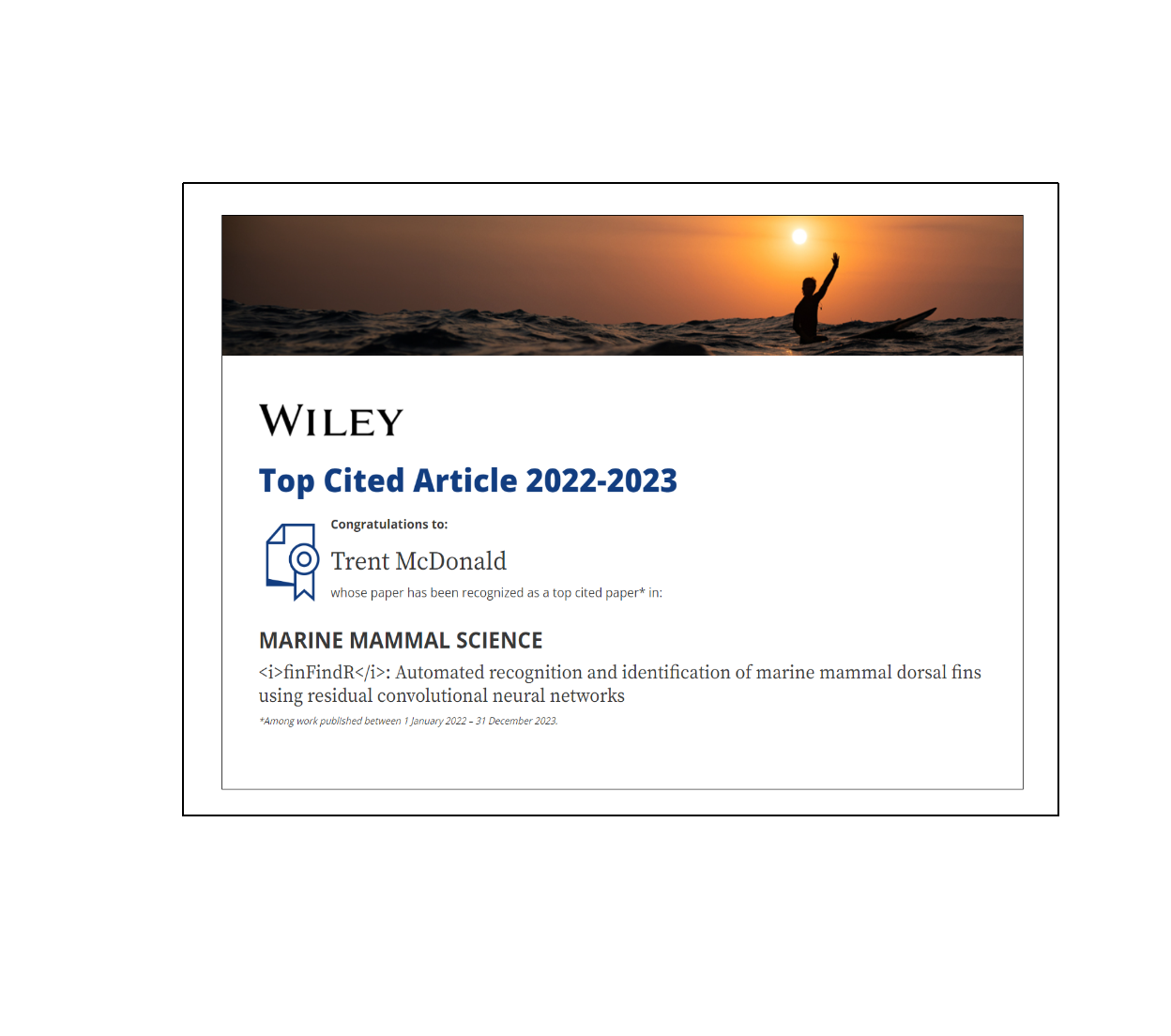
Wiley notified authors of this “Top 10” achievement by email – which is exactly the kind of message that sets off spam alarms. A phishing or marketing email would say much the same thing. In this case, though, the links checked out: they pointed to a legitimate wiley.com subdomain, the certificate (Figure 1) was complimentary, and neither Wiley nor Marine Mammal Science tried to sell me anything.
I spent about half an hour trying to verify the “Top 10” claim independently. The Marine Mammal Science website currently lists 13 citations for the paper. That initially struck me as low for a top-cited article, but I don’t closely track citation rates in marine mammal literature. Thirteen citations over roughly two years works out to about one every two months – respectable, especially given that finFindR is a specialized tool used mainly in dolphin photo-identification studies.
Actually confirming the ranking would take more effort. The straightforward approach would be to pull citation counts for all Marine Mammal Science articles published in the past two years from an aggregator such as Google Scholar, ResearchGate, or Academia.edu, then sort by citation count. Wiley’s email states they used Clarivate Analytics – essentially the modern version of Web of Science and one of the more trusted citation sources – but Clarivate is a subscription service, so I couldn’t check directly. When time allows, I plan to run the same comparison using freely available sources. Done systematically across an author’s full publication list, this kind of citation-frequency ranking would make a useful additional measure of research impact.
For now, I’ll take Wiley at their word. Congratulations to my co-authors – this paper was a serious undertaking, involving years of coding and weeks of validation work, and I’m proud of what we produced. The abstract is here, and the free-to-read paper is here.